
English| EUR
Suggested for you
More currencies
Choose a language
The Heritage Train runs a fixed route between Da Nang and Hue, tracing the central Vietnamese coast through tunnels, bridges, and coastal plains. This page maps the route, explains the departure schedule, and clarifies what the journey covers.
Quick answer
The hai van pass train route connects Da Nang and Hue along the North-South Railway, departing from Da Nang station at 791 Hai Phong Street. Trains operate daily from 07:50 to 17:45, with the standard passenger fare at 210,000 VND per person. The route passes through coastal villages, lagoons, and the eastern foothills before reaching Hue's imperial district.
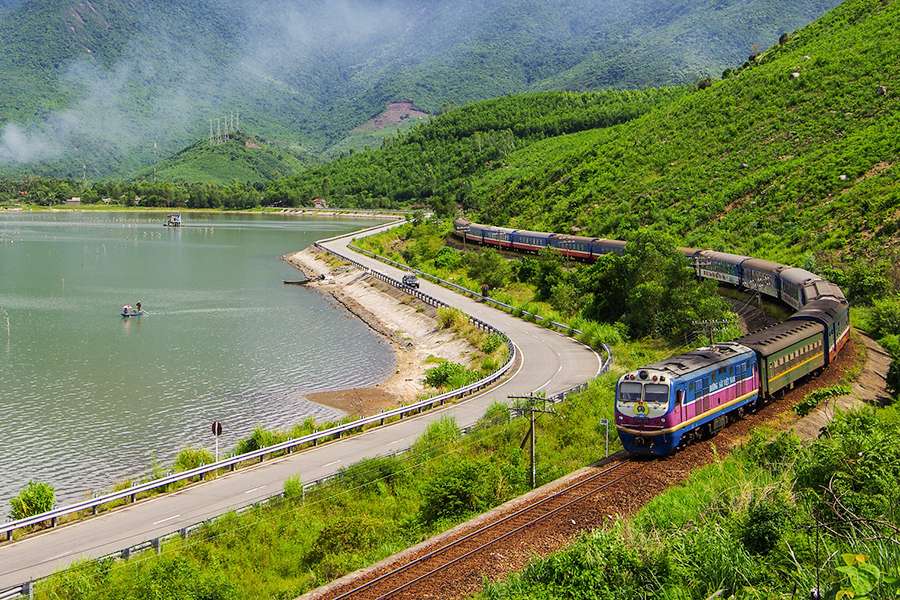
The North-South Railway through central Vietnam was completed in sections between 1936 and 1975, linking the coastal cities that had been divided by colonial boundaries and later by conflict. The Heritage Train service revived a segment of that line as a tourist route in the early 2000s, converting older rolling stock into open-air carriages that emphasize the landscape rather than speed. The hai van pass train route begins at Da Nang station in Thanh Khe District, crosses the Han River delta, and follows the lagoon edge northward. The railway skirts the base of the Truong Son Range, passing through Lang Co village and the narrow coastal corridor before entering Thua Thien-Hue Province. The journey covers roughly 100 kilometers and takes between two and three hours depending on the service and stopping pattern. The route does not cross the Hai Van Pass road summit itself—the railway diverges inland through a series of tunnels and cuts that were engineered to avoid the steepest coastal grades. What passengers see instead is the transition zone: fishing villages, rice paddies irrigated by the Truong Giang and Huong rivers, and the tidal flats that have shaped settlement patterns for centuries. Departures run throughout the day within the operating window, and seats are assigned by carriage type. The train stops briefly at intermediate stations to allow passengers to photograph the surroundings or visit small platform markets. The final approach into Hue follows the Perfume River's southern bank, passing the royal tombs and garden estates that line the water before arriving at the main terminus. Travelers booking the Heritage Train should distinguish it from the standard Reunification Express services, which follow the same track but operate on a faster schedule with fewer scenic pauses. The Heritage service is designed for visitors prioritizing the route itself rather than point-to-point transit. The coastal railway remains one of the few ways to see the transition between Da Nang's urban waterfront and Hue's walled imperial core without committing to the winding cliff road. The route's engineering—low bridges, narrow tunnels, and the reliance on original track bed—means the journey unfolds at the pace the landscape was built to accommodate.
“The railway skirts the base of the Truong Son Range, passing through narrow coastal corridors and lagoon edges that have shaped central Vietnamese settlement for centuries.”
This plan covers the full Da Nang to Hue route on the Heritage Train, ideal for travelers who want to experience the coastal scenery and Hai Van Pass views. The journey takes approximately 2.5 to 3 hours.
Arrive 30–40 minutes before your scheduled departure to collect tickets and find your carriage. Trains depart between 07:50 and late afternoon.
The route hugs the shoreline before climbing inland. Sit on the right side (heading north) for the best ocean views.
The train passes through tunnels under the pass; windows on both sides offer glimpses of the mountains and coast as the line curves. Brief photo opportunities at open sections.
The landscape shifts to lagoons and rice fields as you approach the Perfume River basin. Keep your belongings ready as the train slows into Hue Station.
The Hai Van Pass train route operates on a consistent daily schedule to accommodate passengers traveling between Da Nang and Hue.
The departure point for the Hai Van Pass train route is located at 791 Hai Phong Street, Thanh Khe District, Da Nang City. Visitors can easily reach Da Nang Railway Station via local transport options such as taxis or ride-hailing services.
Direct to 791 Hai Phong Street
Via Le Duan or Dien Bien Phu street to 791 Hai Phong Street
From Da Nang city center towards 791 Hai Phong Street
Plan to arrive at 791 Hai Phong Street 30-40 minutes before your scheduled train time to complete check-in procedures without delay.
Complete these steps before your departure to ensure a smooth boarding experience on the Heritage Train.
Everything you need to know about hai van pass train route
The hai van pass train route refers to the scenic railway segment connecting Da Nang and Hue, known for its passage through the mountains and along the coast. This journey provides passengers with a vantage point of the East Sea and the jungle landscape typical of central Vietnam.
While it uses the national railway tracks, the Heritage Train Da Nang - Hue is a specialized tourist service designed to enhance the passenger experience. Unlike standard regional commutes, this service focuses on comfort and sightseeing opportunities along the historic mountain pass.
The standard passenger fare for the Heritage tourist train is 210,000 VND per person. Please note that prices are fixed and can be confirmed through official channels for travel planning.
It is recommended to arrive 30-40 minutes before your scheduled train time to ensure a smooth boarding process. The best arrival window at the station is between 07:50 and 17:45 daily.
The service operates daily from 07:50 to 17:45, providing consistent access throughout the week. You should check the official schedule on the dsvn.vn website to align your arrival with your specific departure time.
While information is available at 791 Hai Phong Street, Da Nang, travelers should utilize official booking platforms to secure seats in advance. Avoid third-party vendors that may add unnecessary surcharges to the base fare.
When preparing for your trip on the hai van pass train route, ensure you have your identification and booking confirmation ready. The route offers unique photo opportunities, so prepare your camera gear for the coastal views.
This scenic rail journey is generally considered family-friendly and provides a comfortable way for children to see the regional geography without the fatigue of road travel. Ensure your children are supervised during the boarding process at the platform.
Hai Van Pass: Train or Motorbike?
Read more GuideHai Van Pass Train: Hue to Da Nang
Read more GuideHue to Hoi An via Hai Van Pass Train
Read more GuideTraveling the Hai Van Pass by Train
Read more Tickets & toursHai Van Pass Train Tickets
Read more GuideHai Van Pass Train Schedule
Read more